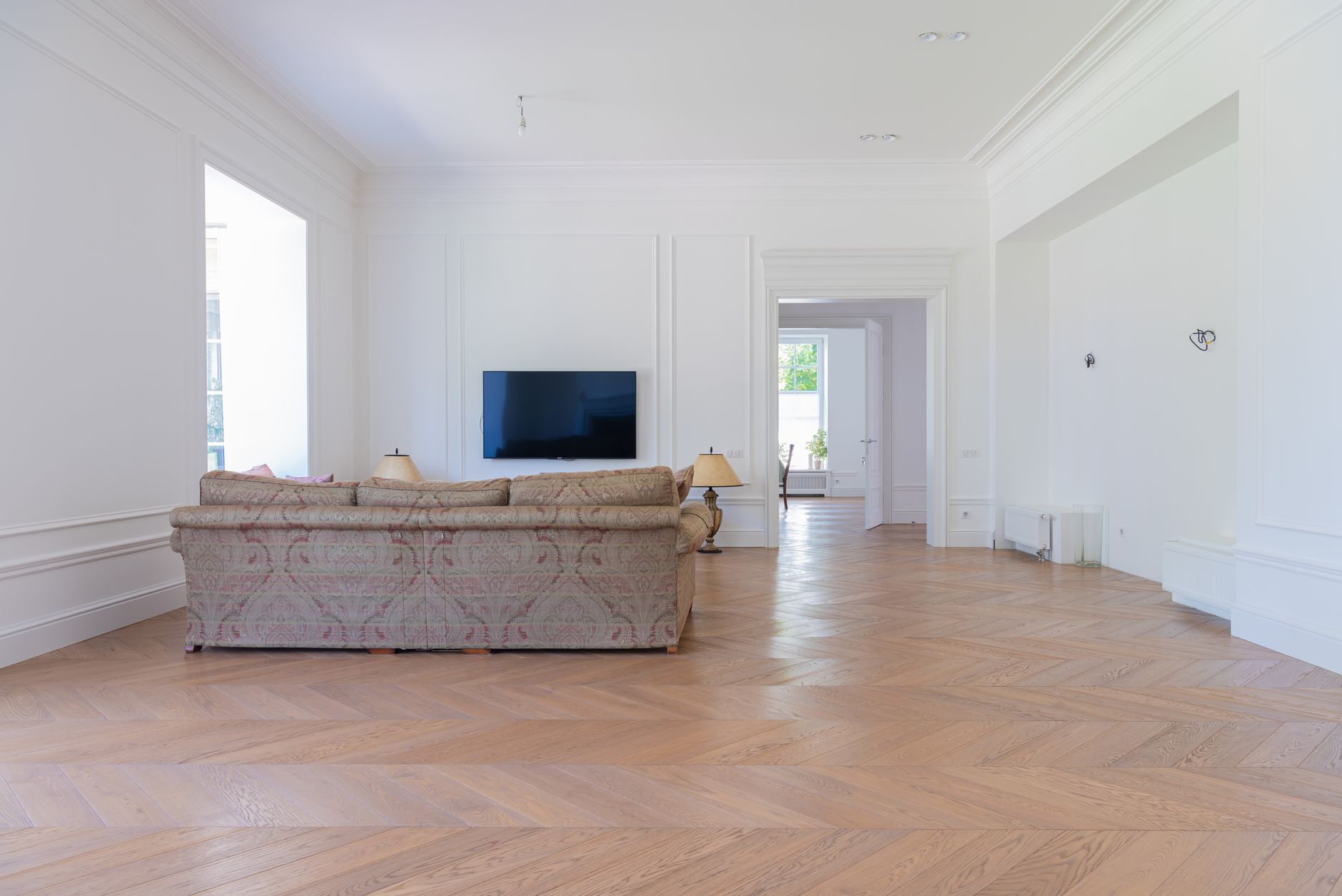
Hardwood Flooring Installation in Philadelphia, PA
What it costs, and what Philadelphia's housing stock does to the job.
Hardwood flooring in a 1949-median city
The median Philadelphia home was built in 1949 and 39.9% of the city’s housing
predates 1940. For hardwood flooring specifically, that is not background color — it is the thing that
decides the job.
A rowhome floor is long, narrow and continuous, and that changes the layout decision before it changes anything else. Boards almost always want to run front to back, along the length of the house — it is the direction that makes a narrow room read wider, and it usually runs across the joists, which is what you want structurally. The complication is the party wall: a shared wall moves differently from an exterior one, and the expansion gap at that edge is not a detail to leave to chance.
Philadelphia is a rowhome city, and a rowhome is a flooring problem with a specific shape: long narrow floors running front to back, a shared party wall on one or both sides, and stairs in the middle of the plan rather than at the end of it. Narrow-strip oak was the default here for decades and a great deal of it is still down, under carpet, in sound enough condition to sand.
What it costs in Philadelphia
Philadelphia metro labor runs above the Pennsylvania baseline, which is why the range below sits higher than the statewide $6–$21. Installed, materials and labor together:
| Work | Philadelphia range | Pennsylvania range |
|---|---|---|
| Hardwood, installed | $6.5 – $22.5 a square foot | $6 – $21 a square foot |
An estimate, not a quote. These are planning ranges for Pennsylvania, not a quote. What you actually pay depends on your rooms, your subfloor and the material you choose — final price depends on your project.
Extras are where a Philadelphia job most often moves away from the band: removing the old floor,
prepping a plank subfloor, and stairs. The
cost estimator prices those separately against your own
room.
Questions worth asking before you book
- What is the subfloor, and what does it need? With 39.9% of Philadelphia
homes predating 1940, a plank subfloor is a realistic assumption rather than an edge case.
How to identify yours. - Is the old floor coming out or being covered? Covering costs less and is
sometimes the safer answer — particularly over
9×9 tile — but it costs you height at doors and
at the bottom stair riser. - What is the cut-and-waste allowance? A century-old house is rarely square, and
cuts are labor. - What is your PA Home Improvement Contractor number? It is legally required to
be on the estimate. How to check it.