Hardwood Flooring Installation in Pennsylvania: Solid vs Engineered, and What It Costs
Hardwood still returns more at resale than anything else on this site, and in a state with the fourth-oldest housing stock in the country it is also the floor most Pennsylvania houses were originally built with.
Solid or engineered — the question is your subfloor, not your taste
People choose between solid and engineered hardwood as though it were a preference. In an older
Pennsylvania house it is usually a structural answer:
- Solid hardwood is one piece of wood, typically ¾ inch. It gets nailed down,
which means it needs a nailable wood subfloor, and it can be sanded and refinished several times
across its life. It moves seasonally, so it does not belong below grade. - Engineered hardwood is a real wood veneer over plywood cross-plies. It is far
more dimensionally stable, which is what lets it go over concrete and into basements, and it can be
glued, nailed or floated. It can only be sanded as many times as the veneer allows — and plenty of
it cannot be sanded even once.
If someone quotes you engineered hardwood, ask for the wear-layer thickness in millimetres before
you compare the price to anything. A 4mm veneer is a floor your grandchildren can refinish. A 0.6mm
veneer is a photograph of a floor.
The Pennsylvania subfloor problem
Houses built before the 1950s frequently sit on 1×6 boards laid diagonally across the joists
rather than on sheet plywood. Solid hardwood is actually happy on that — it is the original assembly
and nailing into diagonal plank is exactly what it was designed for, provided the new flooring runs
across the planks rather than parallel to them.
What that subfloor is bad at is anything that needs a flat continuous surface: floating floors,
thin engineered products, and glue-down. That is why the same house can be a straightforward
hardwood job and an expensive vinyl job, and why a national square-foot calculator gets Pennsylvania
badly wrong.
What hardwood costs in Pennsylvania
Installed, hardwood runs roughly $6 to $21 a square foot in Pennsylvania. That
is a wide band and it is honest. Prefinished oak strip in a straightforward rectangular room sits
near the bottom. Wide-plank white oak, site-finished, with the old floor removed and a subfloor
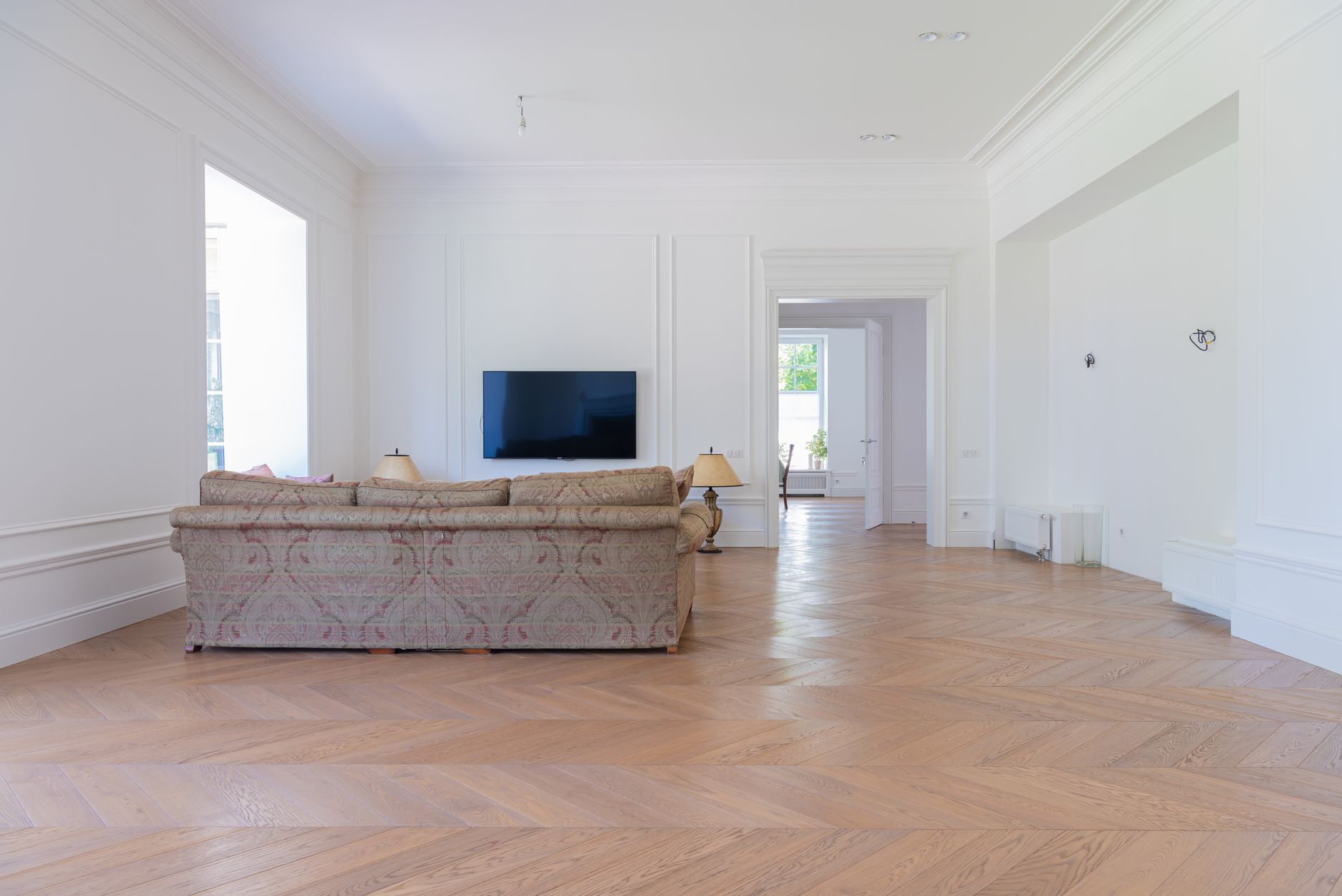
levelled first, sits near the top — and a herringbone or chevron layout adds materially to labor
because of the cutting and the waste.
An estimate, not a quote. These are planning ranges for Pennsylvania, not a quote. What you actually pay depends on your rooms, your subfloor and the material you choose — final price depends on your project.
Two costs people forget: the cut-and-waste allowance, which is typically around 8% on a straight
layout and considerably more on a diagonal or herringbone one, and the acclimation period. Hardwood
needs to sit in the room it is going into, at the humidity it will live at, before it goes down.
Skipping that is how you get gaps in February.
Before anyone picks a species
Old joists deflect more than current code allows. That matters less for hardwood than for tile,
because wood flexes with the structure rather than cracking, but a bouncy floor is still a bouncy
floor, and it is worth knowing about before you spend the money — a sistered joist is far cheaper
before the finished floor is down than after.
Frequently asked questions
Can I install hardwood in my basement?
Not solid hardwood. Below-grade concrete pushes moisture upward and solid wood will cup or crown.
Engineered hardwood over a proper vapor barrier is the usual answer, and rigid-core vinyl plank is
the safer one.
How long does hardwood installation take?
Prefinished hardwood in an average room is typically a one to two day job once the room is clear.
Site-finished adds several days for sanding, staining and coats, plus cure time before furniture
comes back.
Is wide plank a bad idea in an old house?
Not at all — many Pennsylvania houses originally had wide boards. Wide planks do move more across
their width, so they want a stable subfloor and correct acclimation more than a narrow strip does.